

How do you Calculate Load Capacity & Pipe Length in Tube‑and‑Joint Systems?
The Complete Guide to Load Capacity & Pipe Length Calculations in Modular Workstations and Tube‑and‑Joint Systems
In modern lean manufacturing, every detail matters — especially when building modular workstations, flow racks, picking trolleys, roller tracks, and conveyor‑supported structures. The performance of any tube‑and‑joint system depends on two critical engineering fundamentals:
- Accurate pipe length calculations
- Correct load capacity selection for tubes, joints, and rollers
These calculations directly impact safety, ergonomics, 5S compliance, and long‑term durability across industries such as aerospace, automotive, pharmaceutical packaging, FMCG, warehousing, and general manufacturing.
This guide breaks down the essential engineering data you need to design stronger, safer, and more efficient modular systems.
1. How to Calculate Pipe Length in Tube‑and‑Joint Systems
Correct pipe length is essential for building stable lean workstations, flow racks, and industrial picking trolleys. Every joint has an insertion depth, and every structure has a centre‑to‑centre distance that must be accounted for.
Horizontal Pipe Calculation
To calculate the correct pipe length:
- Start with the centre‑to‑centre distance
- Subtract the combined joint insertion depth (35 mm × 2 = 70 mm)
Example: Centre distance: 800 mmMinus joint depth: 70 mmRequired pipe length: 730 mm
This ensures a perfect fit for horizontal rails in flow racks, workbenches, and lean workstation frames.
Vertical Pipe Calculation
Vertical assemblies often include adjusters or footings:
- Begin with the centre‑to‑centre distance
- Subtract the adjuster offset
- Add the joint surface‑to‑centre measurement
Example: Centre distance: 530 mmMinus adjuster offset: 25 mmPlus joint surface offset: 16.5 mmRequired pipe length: 522 mm
Precision here prevents misalignment and uneven load distribution essential for ergonomic workstations and 5S‑compliant structures.
2. Joint Load Capacity: Understanding X and Y Forces
Every tube‑and‑joint workstation experiences force in two directions:
- X direction - horizontal load
- Y direction - vertical load
Both stainless antistatic and plastic‑coated tubes share the same joint limits:
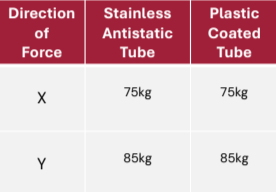
Why this matters: Overloading joints especially in the X direction can cause twisting, slipping, and structural failure. Correct joint selection is essential for aerospace assembly carts, automotive kitting trolleys, and pharma flow racks.
3. Tube Load Capacity: How Length Impacts Strength
Tube strength decreases as length increases - a critical factor when designing:
- Workbench surfaces
- Flow rack rails
- Conveyor supports
- Picking trolley frames
- Roller track structures

Key insight: Longer spans require reinforcement, centre supports, or stronger tube grades especially in high‑density warehousing, automotive assembly lines, and heavy‑duty conveyor systems.
4. Roller & Roller Track Load Capacity for Flow Racks and Conveyors
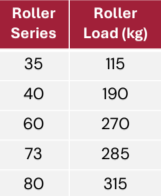
Choosing the right roller series prevents deformation, jamming, and premature wear especially in FIFO flow racks, kanban systems, and high‑volume picking operations.
Maximum Load Per Roller
Maximum Load Per 1000 mm of Roller Track
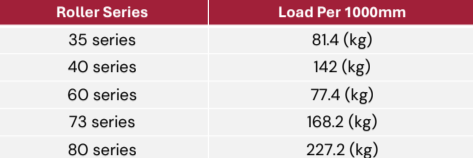
Design tip: For heavy totes, automotive components, or aerospace tooling, Series 73 or 80 rollers provide the best long‑term reliability.
5. Why These Calculations Matter for Lean Manufacturing & 5S
Accurate engineering ensures:
- Safer modular workstations
- Stronger flow racks and FIFO systems
- Reliable conveyors and roller tracks
- Durable picking trolleys and kitting carts
- Ergonomic workbenches that reduce operator fatigue
- 5S‑ready layouts with predictable performance
- Reduced rework, downtime, and maintenance costs
Lean environments depend on predictable, repeatable performance — and that starts with correct load data and precise pipe cutting.
Final Thought: Engineering Drives Lean Success
Tube‑and‑joint systems are powerful because they’re modular, reconfigurable, and ideal for continuous improvement. But they only deliver maximum value when engineered with:
- Correct pipe length calculations
- Accurate load capacity data
- Proper reinforcement
- Industry‑specific design considerations
Whether you’re building for aerospace, automotive, pharmaceutical, FMCG, or warehousing, these fundamentals ensure your structures stay safe, strong, and lean.
Complete Lean Tube
sales@completeleantube.co.uk t: 01949 358 758
Operating Hours: Mon to Fri 9am-5pm
Unit 6, Barbrey Business Park, Orston Lane, Bottesford, Nottingham, NG13 0GY